Not every lead should receive the same level of attention.
Some people are actively researching your services and match your ideal customer profile.
Others may simply have downloaded a guide six months ago.
CRM lead scoring helps businesses distinguish between the two.
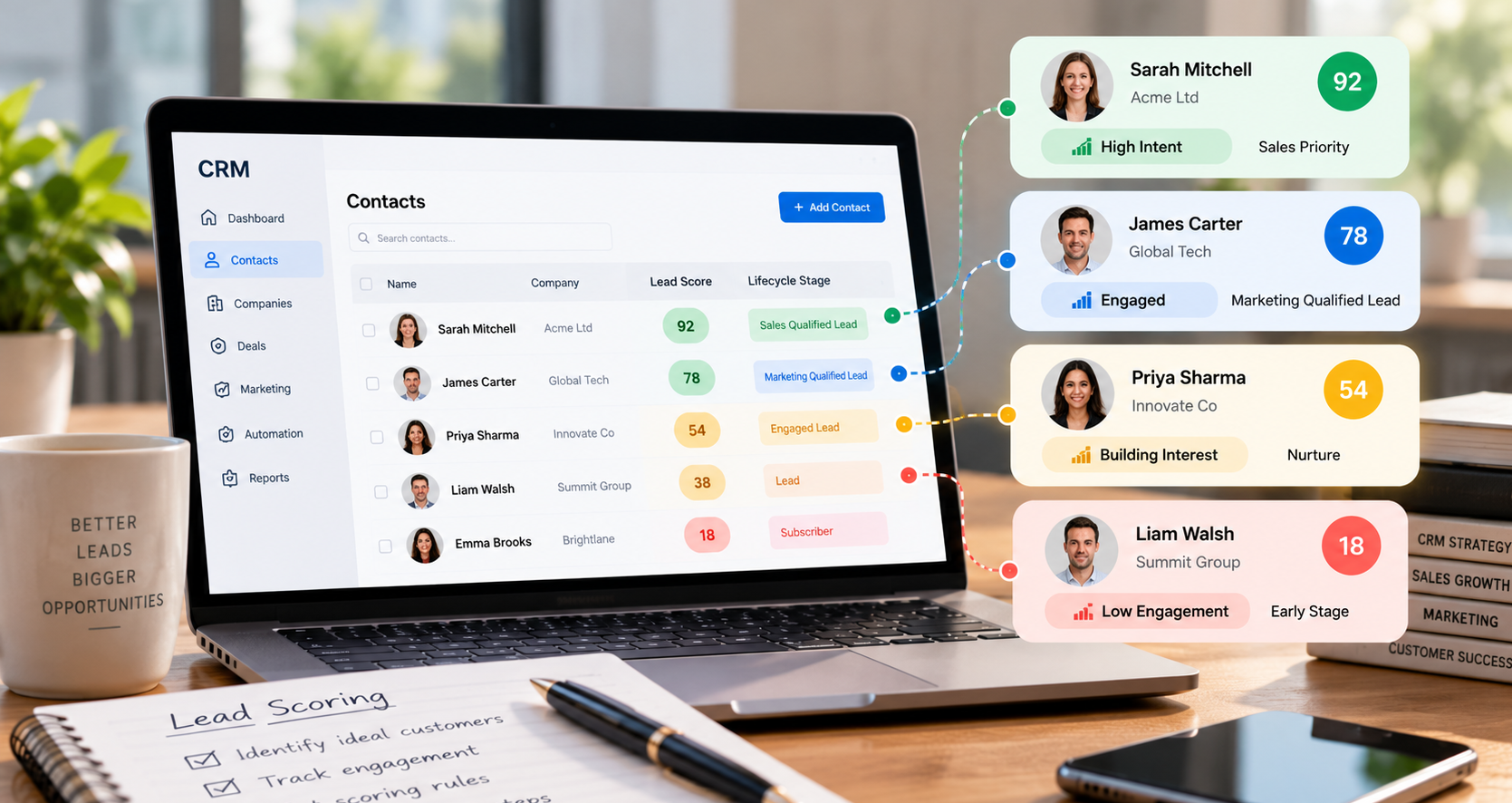
A lead scoring system assigns values to contacts based on characteristics and behaviour.
The goal is to help sales and marketing understand which leads are more likely to become customers.
What Is CRM Lead Scoring?
CRM lead scoring is a method of ranking prospects based on information stored within your CRM.
Points might be awarded for characteristics such as:
- Company size
- Industry
- Location
- Job role
- Service requirements
Additional points can be added when a person demonstrates interest.
For example:
- Visiting an important webpage
- Completing a form
- Opening marketing emails
- Attending a webinar
- Requesting a demo
- Booking a meeting
Once a lead reaches a defined score, it might be passed to sales or placed into a different nurture process.
Why Use Lead Scoring?
Without lead scoring, sales teams may treat every enquiry equally.
This creates two problems.
High-intent leads may not receive attention quickly enough.
At the same time, sales representatives may spend hours chasing people who are not yet ready to buy.
Lead scoring helps prioritise activity.
It can also create clearer alignment between sales and marketing.
Instead of arguing about whether a lead is "good", both teams can work from agreed criteria.
Fit Versus Engagement
A useful lead scoring model usually looks at two things:
Fit
How closely does this person or organisation match your ideal customer?
Fit criteria might include:
- Company size
- Industry
- Location
- Revenue
- Job title
- Technology used
Engagement
How much interest have they demonstrated?
Engagement could include:
- Website activity
- Email engagement
- Form submissions
- Event attendance
- Meetings booked
- Product pages viewed
A contact may have strong fit but low engagement.
Another may be highly engaged but completely outside your target market.
The strongest opportunities often score well in both areas.
Start With Your Best Customers
Before assigning arbitrary points, look at the customers your organisation already wins.
What characteristics do they share?
Which actions normally happen before they become opportunities?
For example, perhaps your strongest customers tend to:
- Have more than 50 employees
- Work in professional services
- Visit your pricing page
- Download two or more resources
- Book a consultation
These patterns can help inform your scoring model.
Avoid Making the Model Too Complicated
One of the most common mistakes in CRM lead scoring is creating an unnecessarily complex system.
You do not need hundreds of rules.
Start with the characteristics and actions that genuinely indicate buying potential.
A simple model might look like:
Ideal industry: +10
Target company size: +10
Decision-maker job title: +10
Visited pricing page: +15
Requested consultation: +30
Then create thresholds.
For example:
0–20 = Early-stage lead
21–40 = Engaged lead
41–60 = Marketing qualified
61+ = Sales priority
The exact numbers matter less than the logic behind them.
Include Negative Scores
Lead scoring should not only add points.
Sometimes behaviour indicates lower buying potential.
Negative scoring can be useful for:
- Students
- Competitors
- Job seekers
- Suppliers
- Contacts outside your target region
- Long periods of inactivity
- Unsubscribing from communications
For example, a competitor email domain might receive -50 points.
This prevents contacts from becoming sales-qualified simply because they have interacted with lots of content.
Decide What Happens When a Score Changes
Lead scoring only becomes useful when it triggers action.
For example:
When score reaches 40 → change lifecycle stage to MQL.
When score reaches 60 → notify sales.
When score reaches 70 → create a follow-up task.
When score falls below a threshold → return contact to nurture.
Automation can handle these steps, but the business rules should be agreed first.
Lead Scoring Is Not a Replacement for Sales Judgement
A score can help prioritise opportunities.
It should not become the only factor salespeople consider.
A lead with a lower score may still be valuable because of information gathered during a conversation.
CRM scoring works best when it supports decision-making rather than replacing human judgement.
Final Thoughts
CRM lead scoring can help sales and marketing focus their attention where it has the greatest chance of creating value.
Start with your ideal customer profile.
Identify meaningful engagement.
Keep the scoring model simple.
Then measure whether higher-scoring leads actually convert.
A good lead scoring model should improve prioritisation rather than add another layer of complexity.